EXCESSIVE AGRRESSIVNESS
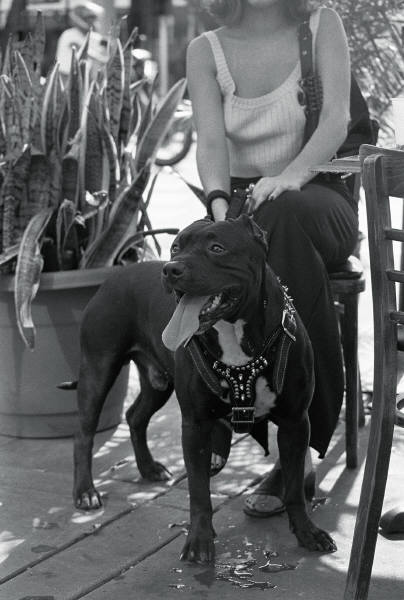
Since dogs are pack animals, you and the other humans he comes into contact with are all part of the pack.As far as your dog is concerned, no pack can exist without a leader, and that leader is either one of you or it's him. That's the way it has to be. You may think that the ideal situation would be that really just want to be friends , on equal terms so to speak with your dog but that for the dog is not really an option ., or peers with your dog. You can indeed be on " best friend" terms with your dog , but for the well-being of your dog you must be the one in charge.
Few dogs actively seek leadership and most are perfectly content for you to assume that role, so long as you do. But you must do so. or even the meekest of dogs will try to take over. Remember, it's not a matter of choice. For every one's safety, you have to be the one in charge and he must be in no doubt whatsoever about this otherwise he imagines himself to be "the boss" and that can only lead to trouble on all fronts . In the dog's mind if he is allowed to be the leader of the pack( and remember his pack comprises of all those other dogs and humans he comes into contact with) he is entitled to exercise
what I will refer to as:-
The Leader of The Pack's Bill of Rights .
I. To eat first, gorge himself, and have an indisputable right to any left overs.
2. To stand, sit, or lie down wherever they want.
3. To have access to the 'prime' spots in the house.
4. To control entry to, or from any room in the house.
5. To proceed through all narrow openings first.
6. To initiate the hunt and dictate where to hunt.
7. To make the 'kill' at the end of the hunt.
8. To demand attention from subordinate pack members.
9. To ignore or actively discourage unwanted attention.
10. To restrict the movements of lesser ranking pack members.
11. To win all games.
By carefully studying this Bill of Rights you can tell who is at the moment the pack leader in your house. If you think it's your dog you must effect a role reversal and establish that you or a member of your family becomes pack leader. This can be achieved by adhering to the following "do's" and 'don'ts."
How to Establish yourself/chosen family member as a Pack Leader :
- DO :
· Eat before your dog
· Restrict access to your bedrooms and furniture
· Take the shortest route to your destination and make your dog move out of your way
· Proceed first through narrow passages
· Run in the opposite direction if your dog 'takes off' on a walk- dont chase after him.
· Take your dog's 'kills' ("stolen" articles or food) away from him immediately and without any hesitation.
· Call your dog to come to you when you want to pat him/ show him affection
· Ignore or discourage pawing, nudging. whining
· Don't be overly affectionate to your dog first thing in the morning, when you get home, or when you come in otherwise he will not only expect that he's first in line for attention but will begin to demand that he is.
· Restrict his movements with the 'Long Down' exercise
· Initiate games with your dog, make sure you win them and end up with possession of the toy
· Reward your dog for completing an exercise well
DON'T
- · Feed your dog first
· Let your dog sleep in or on your bed
· Let your dog restrict your access to anything in the house or take up residence in the doorway
· Let your dog bound out of the door ahead of you so that he's "leading"
· Chase your dog yelling 'COME!
· Allow your dog to keep or play with "the kill"
· Give attention whenever your dog demands it from you
· Make a large fuss over your dog whenever he demands that you do so
· Give more than one command or give up - if he doesn't obey you must administer the prescribed correction to the dog
· Play games, especially tug of war, if you can't win, or give the toy to your dog after the game is over
· Give more than one command, or any command if you are not prepared to reinforce it - Aggressive behaviour is multi-factored. Behavioural changes must begin with awareness through observation and an understanding of the reason for the aggressive behaviour.Below are a few of the causes for aggression in dogs:-
1. Aggression is learned through an excess of rough play which can unconsciously reinforce the dog's notion of his own dominance.
2. Aggressive behaviou can also be a result of over-stimulation of the dog's senses. In my experience over stimulation of the dog's senses of vision and his response to touch are the two senses that will elicit a quick bite. If the dog's sense of hearing Is over stimulated, most dogs will however turn away or try to escape.
3. Aggression can be attributed to the dog's natural instinct to protect his territory.The extent of the area that a dog regards as "his territory"may be restricted to somewhere as small as the dog's sleeping area or food dish. On the other hand it could be extensive
enough to include everything that falls within the area in or within the vicinity of the dog's home/car/yard. This has to be clearly defined to the dog as he will vigilantly defend those areas he regards as belonging to him ie falling within his territory.
4. Dogs can be aggressive when approached while they are eating.Dogs are predatory animals. They chase things that run. In the wild this is their way of avoiding starvation.Their natural instinct is to chase and catch their prey. In the wild they will fiercely protect the prey they catch and in due course begin to eat it. This natural instinct is latent in dogs even when they are domesticated and sometimes when they feel that their food is about to be taken away from them they will respond as they would in the wild...with a bite.This bite is usually a grab and hold action.
Some dogs will automatically snap if approached when eating. This natural reflex must be discouraged.
5. Aggression can be a symptom of discomfort or pain.A dog will bite reflexively when injured and in pain. If the pain is sudden, the bite is quickly released. This is the one case when a snap or bite is forgivable .
6. Aggression can be used by the dog to assert dominancy over other dogs.It's not unusual for male dogs to fight other males to assert their position in respect of a female mate. Sometimes males (and females towards other females) will show aggression simply as a challenge to other dogs. With some dogs, they will have to be kept separate or a constant vigilance will have to be kept when the dogs are allowed contact with each other.
7. Aggression can be used as a way of trying to protect the pups.Nursing females are often extremely protective of their young. Caution must always be used when approaching puppies or the "nesting area" . Common sense has to be used along with an awareness of the mother dog's natural protective instinct which is honed even against
the most familiar family member.
8. Aggression may be indicative of a dog being in a state of fear- I personally feel that the dog who bites out of fear is the most dangerous. They are untrustworthy and unpredictable and can inflict very serious injury.
9. Unexplained aggressions can occur If the dog's thyroid, liver or any other part of the neuro-endocrine system is not functioning correctly. If this situation of unexplained aggression manifests with your hitherto placid pet then your first priority is to confirm that there is nothing affecting the dog's health. The majority of owners of pet dogs are unable to read the body language of the dog. They can even contribute to the crisis by provoking even more aggression by not recognizing that the dog's newly found aggression is a direct result of some physical problem he is enduring. It is vital to
eliminate ill health as the source for the aggressive behaviour by visiting a vet who can thoroughly check the dog's physical health.
10. Genetically inherited aggressive tendencies.Genetics also determine any particular dog's personality of which aggression is only one facet.
In most situations trying to deal with a dog's aggressive behaviour without undertaking a an obedience training course is like trying to drive a car which is equipt with neither brakes nor wheels .
When aggression occurs there is a always a set pattern.......There is always a stimulus present .....followed by a response from the dog and a result he experiences as a direct result of his response. This result will either reinforce or discourage the dog's aggressive
response depending on whether it is pleasant or unpleasant.
To deal effectively with the aggression you must determine what exactly is the underlying stimulus that initiates the dog's aggression.( Once the stimulus has been identified it can then be changed , avoided or removed.) The response is obvious- the aggressive behaviour of the dog. Next, you must change, avoid, or remove the reinforcer or consequence to the undesirable response. Begin with a baseline or frequency count of how often the dog displays aggressive behaviour arid when the response begins to diminish. One can now focus on the acceptable behaviours by teaching the dog to passively inhibit the aggressive response, using positive rewards. Does practice make perfect? Only if the practice is perfect.
